
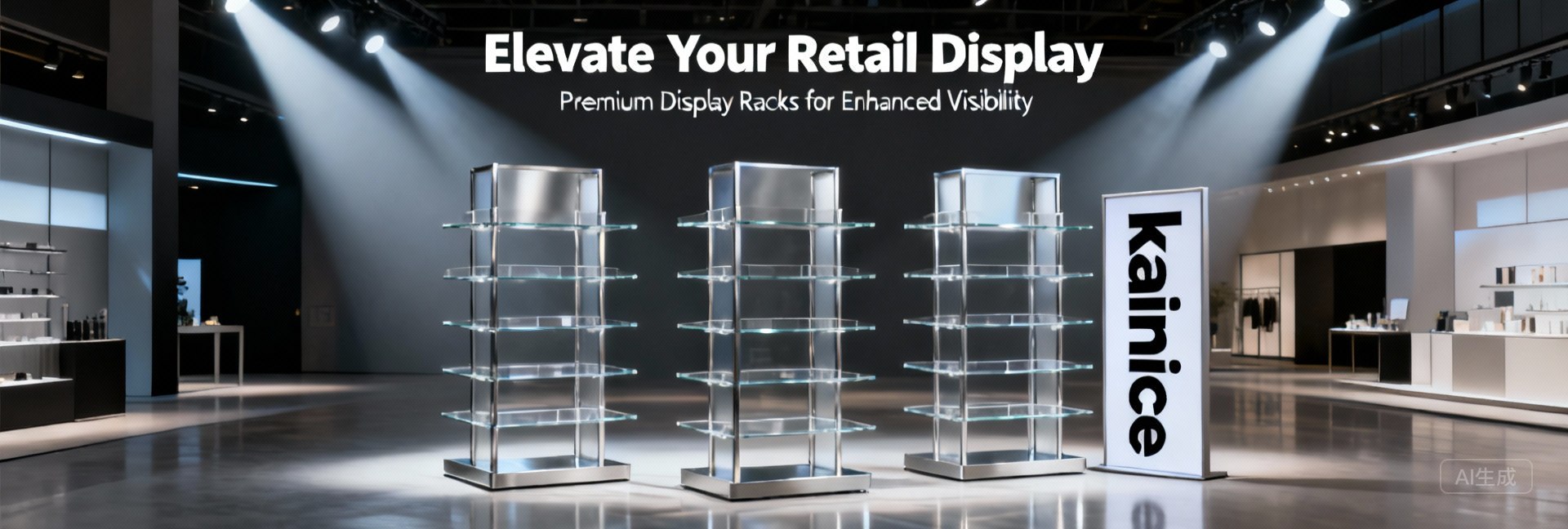
In high-traffic retail environments and modern commercial stores, selecting a heavy-duty, precision-crafted POS Display Racks directly impacts merchandise visibility and brand authority.
The Reality of Retail Fixture Manufacturing
I have spent fifteen years on the factory floor, and if there is one thing I have learned, it is that a POS display rack is not just a piece of metal or plastic. It is a silent salesman that either works for you or creates a liability nightmare. I have seen hundreds of units arrive at retail sites—some standing proud for years, others collapsing in a heap of twisted wire and shattered acrylic within a month. At our facility, we operate under the kndisplay standard, which isn't just a label; it’s a set of rigorous stress-test protocols that ensure we don't ship junk to our clients. If you are a retailer or a brand manager looking to source displays, you need to stop looking at the price tag and start looking at the molecular integrity of the materials.
Material selection pitfalls in POS Display Racks manufacturing
Here is the cold, hard truth about materials: many manufacturers are lying to you about what they use. They will tell you they are using "high-grade acrylic," but they are actually feeding recycled regrind into their extruders. Regrind is brittle. It has a memory of its previous life, and under the constant heat of store halogen lights or the pressure of heavy inventory, it will craze, turn yellow, and eventually snap. We only use 100% virgin methyl methacrylate (MMA) cell-cast acrylic. It costs more, yes, but it doesn't spider-web when you drill a mounting hole.
The same goes for steel. I’ve seen shops using "commercial grade" cold-rolled steel that is actually 22-gauge when they promised 18-gauge. That 0.4mm difference might sound negligible on a spec sheet, but in a retail environment, it is the difference between a rack that stands firm and one that sways like a reed in the wind. Ever wonder why discount display racks start wobbling after two weeks? It’s because the metal is too thin to handle the torque of daily restocking. At kndisplay, we calibrate our laser cutters to a tolerance of ±0.2mm. If the material doesn't meet our density test, it doesn't touch the CNC machine. Don't let a supplier trade your brand’s reputation for a slightly cheaper sheet of scrap-filled plastic.
Engineering POS Display Racks for maximum weight load capacity
I remember a project five years ago where a client insisted on a cantilevered shelf design for heavy glass jars. They wanted a sleek, "floating" look. We warned them about deflection limits. They pushed for a cheaper welding process to save on labor. The result? Three weeks after rollout, we had a failure. The weld penetration was insufficient, the gusset plates were undersized, and the entire unit suffered from metal fatigue. The shelves didn't just sag; they folded under the weight of 30kg of product.

[Figure] POS Display Racks commercial showroom deployment & structural details (Fabrication: kndisplay)
Scene: Powder-coated cold-rolled steel gondola shelves feature precision-aligned, front-faced merchandise. Warm 3000K recessed spotlights illuminate the matte finish against a polished concrete floor, captured in crisp 8k catalog-grade detail for an ultra-professional, high-conversion retail showroom aesthetic.
To hit a verified 50kg per tier capacity, you cannot just rely on the thickness of the metal. You need geometry working for you. We use reinforcement ribs—pressed, not just welded—to add structural rigidity without adding excessive mass. A 50kg capacity is not a suggestion; it is a calculation. We perform static load tests where we leave weights on the rack for 48 hours to measure "creep" or permanent deformation. If the shelf deflects more than 2mm under full load, we redesign the bracket. Is saving $3 on metal gauge really worth a $10,000 product spill in the middle of a busy aisle?
Hot-bending vs cold-forming techniques for POS Display Racks durability
When you are working with acrylic or metal, the way you shape it determines how long it will last. Hot-bending acrylic sounds simple, but if you don't control the temperature within a narrow 5-degree window, you introduce internal stress. That stress is a time bomb. Six months later, the piece will crack right along the bend line for no apparent reason. We use precision-controlled infrared heating elements to ensure the heat penetrates the sheet evenly. If you see bubbles in the bend, the manufacturer rushed the process. It's a sign of amateur work.
For metal, I always prefer cold-forming whenever possible. Cold-forming work-hardens the metal at the bend, actually increasing its strength in the area where you need it most. When we produce high-precision POS units, we use CNC press brakes with programmed pressure curves. This prevents the micro-fractures that occur when you force-bend metal that isn't ductile enough. Every single bent component that comes off our line is inspected under high-intensity lighting for hairline stress fractures. If I can see a mark, it goes into the scrap bin. You shouldn't be paying for a manufacturer's learning curve.
Preventing freight damage and structural sagging in POS Display Racks
Freight is where most retail displays go to die. You can build the most robust, high-tolerance rack in the world, but if it shows up at the store with bent corners or loose fasteners, you have failed. The secret isn't just "more bubble wrap." It is the engineering of the flat-pack design. We use interlocking modular components that rely on positive-fit tabs rather than relying solely on bolts to hold the structure together. When a rack is designed to be self-supporting through its own geometry, it resists vibration-induced racking during transit.
We use a pearl foam packaging system that is custom-molded to the specific weight distribution of the unit. We don't use loose-fill peanuts—they shift, and they are a waste of space. By investing in a design that minimizes the number of loose parts and maximizes the structural integrity of the flat-pack, we’ve reduced our freight damage rate to near zero. It adds about 5% to the initial packaging cost, but it saves 15% on the total procurement lifecycle because you aren't paying to ship replacements for damaged goods. Every rack we ship under the kndisplay name is subjected to a drop-test cycle that simulates the reality of a courier hub. If the box isn't ready for a rough ride, the product inside isn't ready for a retail floor.