
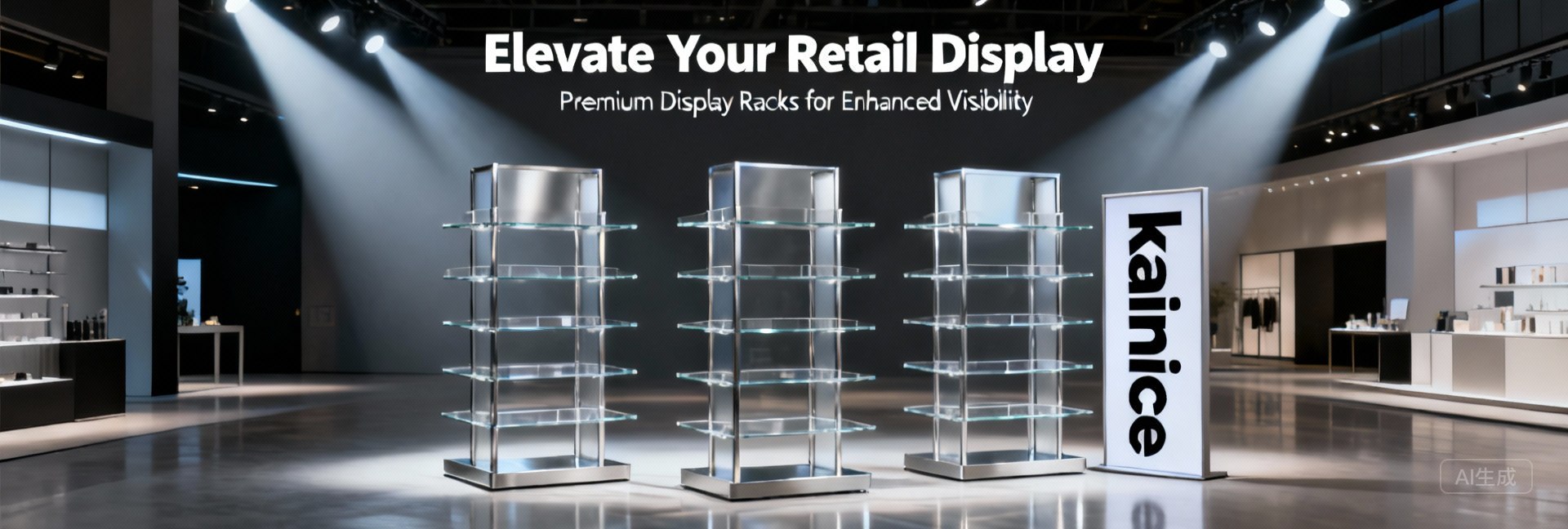
In high-traffic retail environments and modern commercial stores, selecting a heavy-duty, precision-crafted POP Display Racks directly impacts merchandise visibility and brand authority.
The Anatomy of Retail Durability
I’ve spent 15 years on the factory floor, and if there’s one thing I’ve learned, it’s that a retail display isn’t just a piece of furniture—it’s a silent salesman. If it fails, your brand fails. I’ve seen thousands of units come off the line, and I’ve seen just as many come back as scrap because someone tried to shave a few cents off the gauge thickness. At kndisplay, we don't play that game. We build for the reality of a busy retail aisle, where shopping carts hit displays and customers pull products off shelves with zero regard for structural integrity.Engineering tolerances for custom POP Display Racks: Laser cutting vs mechanical punching
The difference between a display that stands proud for three years and one that wobbles like a newborn calf comes down to the math. We hold our shop to a strict ±0.2mm tolerance. Most discount shops will tell you ±0.5mm is "industry standard." They are wrong. When you’re dealing with modular components that need to snap-fit or bolt together without manual shimming, that extra 0.3mm of slop is a disaster waiting to happen. Ever wonder why discount display racks start wobbling after two weeks? It’s because the mechanical punching process used to create the mounting holes was sloppy. Mechanical punching is great for high-volume, low-cost production, but it leaves a slight taper in the hole. If your punch dies aren't sharpened and replaced on a strict schedule, that hole becomes an oval. When you bolt that to a vertical upright, the joint isn't tight. It’s loose. At kndisplay, we prefer CNC laser cutting for any project requiring precision fitment. A laser cut is perfectly clean, with zero burrs and consistent hole geometry. Sure, mechanical punching is faster for a run of 50,000 units, but for high-end custom POP displays, the laser provides a structural rigidity that punching simply cannot match. If you are ordering a high-traffic floor display, demand a laser-cut prototype. If the manufacturer refuses, they are hiding behind inefficient tooling.Material selection pitfalls for POP Display Racks: Virgin plastics vs regrind resin
Here is a story from the floor that still haunts me. A client once brought us a set of acrylic shelf-talkers and header cards that had shattered in a store in Arizona. The manufacturer had used "regrind" acrylic—plastic recycled from scrap and re-melted. It’s cheap, it looks like acrylic when it’s fresh, but it’s brittle. It has no molecular memory. When you use virgin, cell-cast acrylic, you get long-term clarity and impact resistance. When you use regrind, you’re just buying a ticking time bomb. You can identify the junk by looking for "milkiness" or microscopic bubbles at the edges of the sheet. If you see those, run. For kndisplay, we stick to 100% virgin resin. We also treat our acrylic with UV stabilizers. Without these, retail store LED or fluorescent lighting will yellow your display within six months. If your display looks like it’s been sitting in a smoker's lounge after half a year, your brand image is taking a hit. Always ask your manufacturer for the material spec sheet. If they can’t provide a certificate of origin for the resin, they’re using scrap. Don't risk a product spill over a $5 material saving.Preventing structural failure in POP Display Racks: Load capacity testing and sag analysis
I once watched a 4-tier wire display rack buckle under the weight of canned goods because the engineer used 22-gauge wire for the shelf supports. It should have been 18-gauge, minimum. The shelf sagged, the product slid forward, and the whole thing turned into a domino effect of bent metal and broken glass. We perform a standard 50kg (110lbs) load test per tier for our heavy-duty floor displays. If it bows more than 2mm under that load, it goes back to the drawing board. To combat sagging, we don’t just rely on thicker metal; we use gussets. A simple triangular steel gusset welded into the corner of a shelf frame adds more structural rigidity than doubling the thickness of the wire. We also incorporate cross-bracing on the back of our racks. It’s the difference between a display that stands rigid and one that shears under lateral force. If your manufacturer isn't talking about "sag analysis," they aren't engineers—they’re just assemblers. Is saving $3 on metal gauge really worth a $10,000 product spill? I don't think so.Hot-bending vs cold-forming techniques for metal POP Display Racks durability
This is where the craftsmen separate themselves from the amateurs. Cold-forming metal—like bending wire or tubes at room temperature—is the standard for mass production. It’s fast and cheap. However, if you bend a high-tensile steel tube too sharply, you create micro-fractures in the grain of the metal. You might not see them, but they’re there. Over time, with the vibration of a retail floor, those micro-fractures propagate. Eventually, the leg snaps. We use hot-bending for any critical structural joint. By heating the metal to the correct annealing temperature, we allow the crystalline structure to flow rather than snap. It preserves the integrity of the material. When we manufacture at kndisplay, we apply a powder coating with a 60-80μm micron rating. Why so thick? Because a thin coat is just paint; a 60-80μm coat is a protective shield. It prevents the moisture in the air from reaching those bends, which stops rust from starting at the stress points. If you see a display where the paint is flaking off at the corners, that’s a manufacturer who didn't understand the relationship between bend radius and surface tension. Manufacturing is about trade-offs. You can build a display that looks great in a photo for a week, or you can build one that survives the retail environment for years. Every weld we perform, every sheet we cut, and every coating we apply is designed to handle the abuse of the real world. We keep our tolerances tight, our materials pure, and our engineering honest, because at the end of the day, our name is on the floor with your product.
[Figure] POP Display Racks commercial showroom deployment & structural details (Fabrication: kndisplay)
Scene: Powder-coated cold-rolled steel POP Display Racks showcase products in precise, front-faced rows. 3000K recessed spotlights illuminate the matte finish against a polished concrete floor, captured in crisp 8K resolution with professional, high-contrast retail showroom aesthetics.
💡 Factory Veteran Tip:
Every retail chain and storefront layout has distinct footprint constraints and load-bearing requirements. Before signing off on bulk POP Display Racks manufacturing orders, always demand certified load analysis drawings and a physical sample evaluation. At kndisplay, our engineering team provides free prototype evaluations and B2B fixture consulting for brands worldwide.