
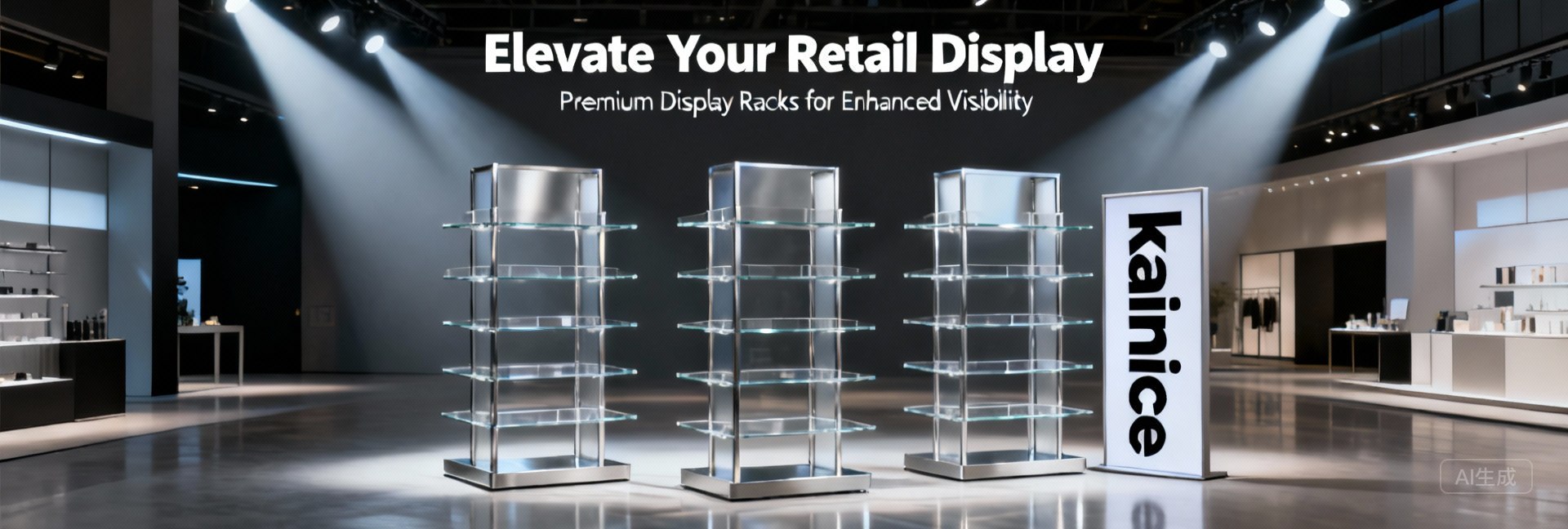
In high-traffic retail environments and modern commercial stores, selecting a heavy-duty, precision-crafted Retail Display Rack directly impacts merchandise visibility and brand authority.
The Reality of Retail Fixture Engineering
I’ve spent 15 years on the factory floor, and if there is one thing I’ve learned, it’s that a display rack isn’t just a piece of furniture—it’s a silent salesperson. If it wobbles, your product looks cheap. If it sags, your brand integrity drops with it. At kndisplay, we’ve spent years refining our production to ensure that every rack leaving our facility meets strict structural engineering benchmarks. I’ve seen too many retailers lose thousands in inventory because they bought a rack based on a pretty photo rather than the internal weld structure. Let’s talk about what actually happens when you put metal and acrylic to work.Retail Display Rack material selection: avoiding structural failure and sagging
The most common mistake I see retailers make is ignoring the gauge of the steel. I’ve walked into shops where the center shelves were bowing like a hammock after just three months. Why? Because the manufacturer used 22-gauge steel instead of the required 18-gauge or 16-gauge for a high-load area.
Here is the truth: a 0.8mm (22-gauge) cold-rolled steel tube is fine for a light greeting card rack, but if you are displaying heavy electronics, jars of honey, or hardware, you are asking for a collapse. We use 1.2mm to 1.5mm steel for any load-bearing uprights.
I once worked with a high-street chain that sourced cheap imported racks. They saved $15 per unit on the front end. When they loaded their inventory, the shelves began to sag by 15mm under the weight. Within a week, the stress points at the shelf brackets started to shear. The cost of shipping those racks back, plus the lost sales and damaged inventory, was easily ten times the original savings.
When you order, ask for the actual measurement. Don't let them tell you it’s "heavy duty." Ask for the gauge. If they can’t provide a spec sheet that confirms a load capacity of at least 50kg (110lbs) per tier, walk away. At kndisplay, we enforce a standard where we verify the material thickness with digital calipers before a single tube hits the saw. If it doesn't hit our kndisplay structural durability index, it doesn't get welded.
Precision engineering for Retail Display Rack: laser tolerances vs cold-forming techniques
Ever wonder why discount display racks start wobbling after two weeks? It’s almost always a tolerance issue. If your CNC laser cutting is off by more than ±0.2mm, your snap-fit joints will never be tight. When the joints are loose, the entire rack relies on the friction of the fasteners, which eventually vibrates loose with store traffic.
Cold-forming is my preferred method for structural integrity. When you hot-bend metal, you introduce heat-affected zones that can weaken the steel’s crystalline structure, making it brittle. Cold-forming keeps the metal’s strength intact.
For our modular systems, we use fiber laser cutters that operate with a tolerance of ±0.1mm. This ensures that when a store associate puts the unit together, the pieces lock into place with zero play. If you can shake the rack and hear a rattle, the engineering is flawed. Is saving $3 on a laser-cut part really worth a $10,000 product spill when the unit eventually collapses? I’ve seen it happen. Don't do it.
Retail Display Rack load capacity testing: how to prevent freight damage and shelf collapse
Shipping is where most display racks die before they ever hit the showroom floor. If a rack isn't braced correctly, the vibration during transit will crack the powder coat or bend the frames. We subject our racks to a "drop test" protocol: we pack the unit in double-wall corrugated cardboard with high-density pearl foam corner protectors and drop it from a height of 80cm on all six faces.
If the powder coating chips or the frame shifts by more than 1mm, we go back to the drawing board. We use a 60-80μm powder coat thickness. Anything thinner than 60μm leaves the metal exposed to humidity, leading to rust—especially in stores where the floor is mopped daily.
Dynamic load testing is another vital step. We don't just put weights on a shelf; we simulate the "bump" of a shopping cart hitting the base. If the base isn't welded with full-penetration fillets, the impact will snap the welds at the baseplate. We use a 360-degree weld pattern on all critical joints to ensure the unit stays rigid under the daily grind of a busy retail environment.
Cost breakdown and maintenance tips for a durable high-traffic Retail Display Rack
When you audit a quote, look at the finishing process. Cheap manufacturers skip the sandblasting or chemical degreasing phase before powder coating. If the steel isn't perfectly clean, the powder won't adhere to the pores of the metal. You’ll see the coating flaking off in sheets after a year.
Here is my procurement checklist for you:
- Weld Inspection: Are the welds ground flush, or are they blobs of slag? Clean welds are a sign of a disciplined factory.
- Coating Thickness: Ask for a 60-80μm micron rating. If they say "standard," ask for the specific test report.
- Hardware Quality: Are they using zinc-plated grade 8.8 bolts or cheap, soft-metal screws that strip the moment you use a power driver?
- Base Stability: Does the design include adjustable leveling feet? If your floor isn't perfectly flat—and it never is—your rack will wobble.

[Figure] Retail Display Rack commercial showroom deployment & structural details (Fabrication: kndisplay)
Scene: A matte black powder-coated steel rack holds luxury skincare serums on diamond-polished 4.5mm clear acrylic shelves. Set against a minimalist terrazzo floor, warm 3000K recessed LED spots highlight the products. Shot in 8k, the scene features soft, professional commercial depth.
💡 Factory Veteran Tip:
Every retail chain and storefront layout has distinct footprint constraints and load-bearing requirements. Before signing off on bulk Retail Display Rack manufacturing orders, always demand certified load analysis drawings and a physical sample evaluation. At kndisplay, our engineering team provides free prototype evaluations and B2B fixture consulting for brands worldwide.