
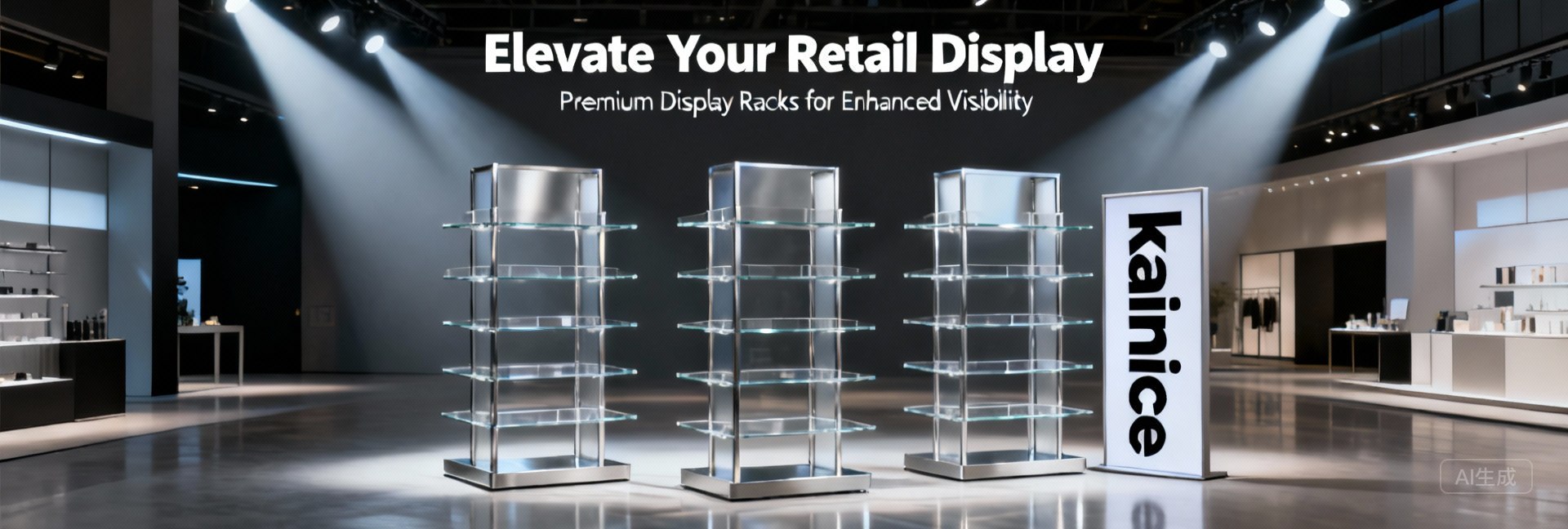
In high-traffic retail environments and modern commercial stores, selecting a heavy-duty, precision-crafted Custom Retail Display Fixture directly impacts merchandise visibility and brand authority.
The Reality of Manufacturing Custom Retail Display Fixtures
I’ve spent 15 years on the shop floor, and if there’s one thing I’ve learned, it’s that a display fixture isn’t just a piece of furniture—it’s a silent salesman. If it’s built like garbage, your product looks like garbage. I’ve seen retailers lose thousands in inventory because they tried to save a few bucks on the gauge of the steel or the quality of the acrylic. At kndisplay, we don’t gamble with those margins. We build to a standard that ignores the "good enough" mentality of the mass-market suppliers who are just looking to flip a container and disappear.Custom Retail Display Fixture material selection: virgin acrylic vs. recycled blends
Let’s talk about acrylic. You’ll see quotes from overseas factories that look dirt cheap, and they’ll tell you it’s "high-quality plastic." Don’t believe it. Most of the time, they are using recycled regrind. This is plastic scrap that has been melted down and extruded again. It’s brittle, it’s full of impurities, and it will turn yellow under standard store LED lighting in less than six months. I remember a project five years ago for a national cosmetic chain. They went with the lowest bidder for their countertop testers. Within three months, the UV radiation from the store lights caused micro-fractures to spiderweb across the shelves. The material literally started crumbling. We had to go in and replace 400 units at a massive loss because the original manufacturer used regrind that couldn't handle the heat of the retail environment. At kndisplay, we only use 100% virgin cell-cast acrylic. It’s more expensive, but it has superior molecular weight and clarity. When we perform a stress test, our 5mm virgin sheets handle load distribution without the "crazing" effect that plagues recycled sheets. If you’re putting high-end merchandise on a display, do you really want a material that gets cloudy and brittle? Is saving 15% on material costs worth the look of a cheap, yellowing fixture in your flagship store?Engineering a Custom Retail Display Fixture for maximum weight load capacity
Most manufacturers think "strong" just means using thicker steel. They’re wrong. It’s about the geometry of the load. If you’re displaying heavy items like bottled spirits or power tools, you need to look at the deflection limit. We calculate the stress points on every bracket and shelf. A standard 18-gauge cold-rolled steel tube might feel sturdy, but if you hang 50kg (110lbs) on a cantilevered arm without accounting for the moment of force, that arm will sag, and your display will look like it’s drooping. We enforce a strict engineering protocol at kndisplay. For every heavy-duty display, we analyze the load-bearing capacity of the base plate. If the base isn’t weighted correctly or if the mounting points aren’t reinforced, the whole thing will wobble when a customer brushes against it. We design our floor stands with a minimum 2:1 safety factor. If the shelf is rated for 50kg, it’s tested at 100kg. We’ve seen competitors use 22-gauge steel for shelving; it’s flimsy, it flexes under pressure, and it’s a liability waiting to happen. Why risk a $10,000 product spill because you wanted to save on a few millimeters of steel thickness?Hot-bending vs. cold-forming techniques in Custom Retail Display Fixture manufacturing
The way you shape your metal and plastic dictates how long the fixture lasts. Many shops use high-speed, sloppy hot-bending techniques that introduce massive internal stress into the material. When you bend acrylic too fast or at the wrong temperature, you’re creating internal tension that eventually leads to spontaneous cracking. We use precision CNC laser cutting with tolerances set at ±0.2mm. When we bend, we use controlled, slow-cycle heating elements to ensure the molecular structure isn't compromised. The same logic applies to our metal fabrication. We prefer cold-forming for structural frames because it maintains the integrity of the steel grain. If you heat-bend structural steel, you’re often weakening the very point where the load is greatest. We look for a clean 90-degree angle with a consistent radius. If you see white stress marks at the bend, that’s a red flag. That’s a manufacturing shortcut that will lead to a failure point within a year.Preventing freight damage and structural sagging in your Custom Retail Display Fixture
The most frustrating part of this business isn't the production; it's the shipping. I’ve seen beautiful, custom-engineered displays arrive at a store looking like they went through a war zone because the factory didn't understand flat-pack physics. If you don't reinforce the joints for flat-pack shipping, the vibration of the truck will loosen every screw and crack every weld. We utilize a specific joint design—typically a cam-lock and bolt combination—that ensures rigidity even after the fixture has been knocked around by a freight carrier. We also demand 60-80μm thickness for our powder coating. Anything less, and you’re going to see chipping at the corners the moment the store staff starts assembling the units. I recall a client who complained about "structural sagging" on a wall-mounted unit. When we investigated, it turned out the factory had shipped the units stacked horizontally without enough pearl foam protection, causing the weight of the top units to permanently warp the steel frames of the ones at the bottom. We learned from that. Now, at kndisplay, we conduct drop-tests on our packaging to simulate the realities of LTL (Less-Than-Truckload) shipping. If the packaging can’t survive a 3-foot drop, it’s not going on the truck. You need to ensure your manufacturer is thinking about the journey, not just the destination. A fixture that breaks during installation is a total loss of your time and your marketing budget. Don't let a cheap shipping box ruin a high-end display investment.
[Figure] Custom Retail Display Fixture commercial showroom deployment & structural details (Fabrication: kndisplay)
Scene: A diamond-polished 4.5mm clear acrylic display rests on a matte black powder-coated steel frame, showcasing luxury skincare serums. 3000K recessed LED spots highlight the bottles against a minimalist terrazzo floor. 8k commercial photography captures crisp details with soft depth of field.
💡 Factory Veteran Tip:
Every retail chain and storefront layout has distinct footprint constraints and load-bearing requirements. Before signing off on bulk Custom Retail Display Fixture manufacturing orders, always demand certified load analysis drawings and a physical sample evaluation. At kndisplay, our engineering team provides free prototype evaluations and B2B fixture consulting for brands worldwide.