
A well-chosen Wall Mounted Garment Rack converts empty vertical space into profitable selling territory. For boutique owners, brand buyers, and wholesale distributors, this fixture category has become one of the most requested items in modern store fit-outs. It keeps garments at eye level, frees the floor for circulation and feature displays, and delivers a clean, architectural look that adapts to almost any brand identity. This guide breaks down the types, materials, installation requirements, and sourcing considerations that matter most when specifying wall mounted clothing racks for a commercial environment.
Why Wall Space Is the Most Undervalued Asset in a Store
Retail rents keep climbing while store footprints shrink. Traditional floor-standing rails occupy valuable square footage and add visual clutter. Wall garment display systems reverse the equation: garments go vertical, the floor stays open, and every linear meter of wall becomes merchandising capacity.
There is also merchandising logic behind the shift. A wall line works like a gallery—products sit front-and-center at eye level, which lifts perceived value and guides customers naturally from the entrance toward fitting rooms and cash desks. Retailers who convert a blank wall into a structured hanging system often gain usable display capacity without expanding the lease.
Main Types of Wall Mounted Garment Racks
Not every wall fixture does the same job. Most commercial projects combine two or three of the following formats:
- Straight hanging rails — the workhorse. A single linear bar maximizes side-hanging density while keeping the display visually quiet.
- Face-out and waterfall arms — garments face the customer, ideal for new arrivals and hero pieces where impact matters more than capacity.
- Double-tier rails — two rows of hanging at different heights nearly double the capacity of one wall section, useful for shirts, trousers, and folded stock.
- Slatwall and panel systems — slotted panels accept rails, hooks, and shelves at any position, so the layout can evolve with every season.
- Rail-and-shelf combinations — hanging above, shelving below: the standard formula for denim walls, accessories, and shoe zones.
Materials and Finishes Compared
Material choice determines strength, lifespan, and the story your fixtures tell. The most common options in commercial production:
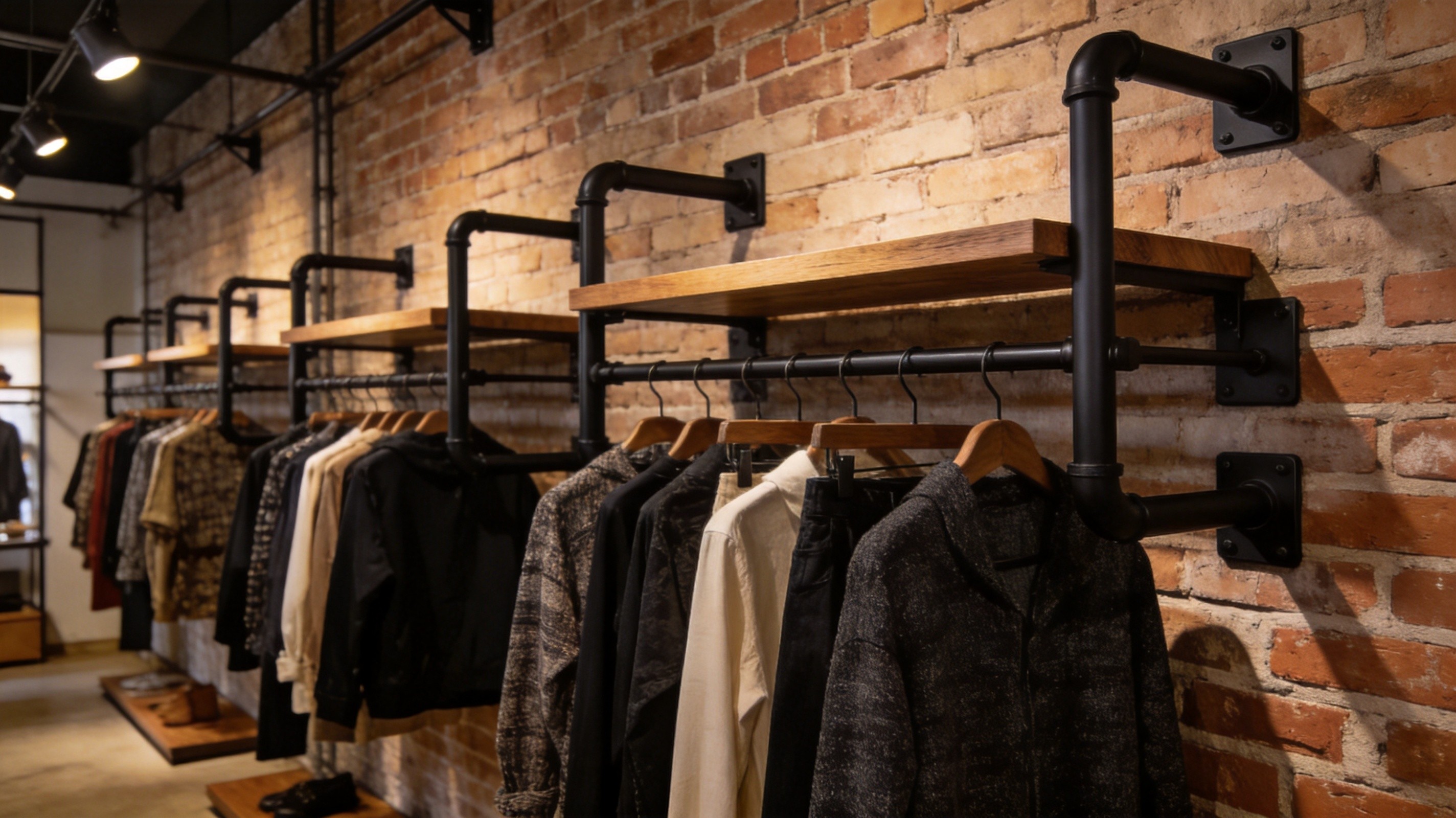
- Carbon steel with powder coating — the industry default for a heavy-duty wall mounted garment rack. Tube thicknesses of 1.0–1.5 mm handle dense outerwear walls, and powder-coat colors such as matte black, brushed gold, or white align with most brand palettes.
- Stainless steel — corrosion-resistant and easy to clean, suited to humid climates and premium minimalist interiors.
- Aluminum — lightweight and rust-proof, a practical choice for modular displays and pop-up formats that get reconfigured frequently.
- Wood-and-metal hybrids — solid wood shelves or back panels soften the industrial look, popular in childrenswear and lifestyle stores.
Finish quality matters as much as the base material. Ask suppliers about coating adhesion, salt-spray performance, and weld finishing before committing to a bulk order.
Installation and Load Capacity: What Buyers Must Verify
A rack is only as strong as the wall behind it. Load capacity is a partnership between the fixture and the substrate it anchors to, so wall mounted garment racks should always be specified together with their fixing method:
- Know the wall type. Drywall requires anchoring into studs (commonly spaced 40–45 cm) or a plywood backer strip; masonry walls take sleeve anchors for the strongest hold.
- Match height to garment length. Long coats and dresses need roughly 160–170 cm of clear drop; a double-tier layout typically runs a lower row at 90–100 cm and an upper row near 180 cm.
- Keep hangers off the wall. A rail center axis about 28–30 cm from the wall prevents garments from rubbing against the surface.
- Support long spans. Bars longer than about one meter need an intermediate bracket to stop sagging under load.
- Do the weight math. A shirt weighs 0.2–0.3 kg, but a winter coat can reach 2–4 kg. One densely packed meter of outerwear can exceed 60 kg—far beyond what drywall alone can carry.
Matching the Rack to Your Store Format
The right specification depends on how the space operates day to day:
- Small boutiques — one straight rail plus a face-out arm near the window balances density with storytelling in limited square meters.
- Flagship and department stores — continuous slatwall or panel systems keep visual rhythm consistent across long wall runs while allowing frequent re-merchandising.
- Kids' and lifestyle stores — rail-and-shelf combinations at reduced heights keep products within reach and leave room for props and signage.
- Pop-ups and shop-in-shops — lightweight aluminum systems with minimal fixings speed up installation, removal, and reuse.
What Wholesale and OEM Buyers Should Evaluate Before Ordering
For procurement teams sourcing directly from manufacturers, the unit price tells only part of the story. A capable supplier of custom wall mounted garment rack solutions should demonstrate:
- OEM/ODM capability — in-house design and tooling to adapt dimensions, colors, and logo details to your brand standards, rather than forcing a catalog item onto your store concept.
- Material and finish control — stated tube thickness, powder-coat adhesion testing, and consistent color batches across a multi-store rollout.
- Verified load testing — a rated capacity per rail backed by test reports, not just marketing figures.
- Sensible MOQs and export packaging — flat-pack cartons that cut freight cost, with hardware kits and installation instructions included in every box.
- Reliable lead times — clear production schedules, pre-shipment inspection options, and documentation that meets destination-market requirements.
Share your floor plan, garment mix, and brand guidelines with the factory at the inquiry stage. Manufacturers can then propose the right mix of rails, panels, and shelves—and quote accurately for both sample validation and volume production.