
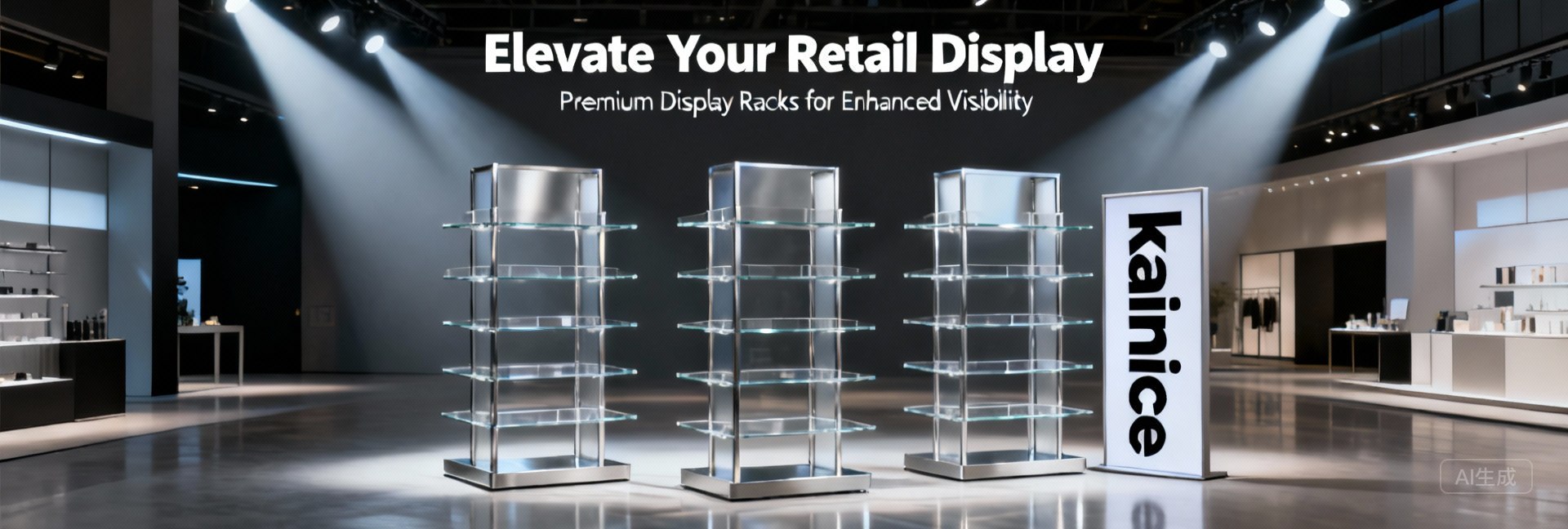
In high-traffic retail environments and modern commercial stores, selecting a heavy-duty, precision-crafted OEM Clothing Display Rack directly impacts merchandise visibility and brand authority.
The Reality of Retail Fixture Engineering
I’ve spent the last 15 years on the shop floor, and if there’s one thing I’ve learned, it’s that a display rack is only as good as its weakest weld. I’ve seen retailers lose thousands in stock because a rack buckled under a heavy coat display, and I’ve seen beautiful stores ruined by cheap, peeling finishes. When we talk about OEM manufacturing, we aren't just talking about bending metal; we’re talking about load-bearing physics and retail longevity. At kndisplay, we hold our production to a strict standard because we know that when the customer walks through your door, the rack shouldn't be the thing they notice—the clothes should be.Preventing Structural Sagging in OEM Clothing Display Rack Manufacturing
Ever wonder why discount display racks start wobbling after two weeks? It usually comes down to a fundamental misunderstanding of static load versus dynamic stress. A rack holding 50kg of summer silk is a very different beast than one holding 50kg of heavy winter parkas. When we design for kndisplay, we calculate for the "hang-weight" plus a 20% safety margin for the inevitable customer who pulls on the rack. The biggest mistake I see in the industry is using 22-gauge thin-walled tubing for high-traffic areas. It looks fine on day one, but after six months of constant vibration and load, it develops a permanent bow. We address this by using internal gussets at every intersection point. A simple butt-weld isn't enough. If you’re sourcing OEM, demand to see the weld penetration. If the tube is 1.2mm thick, the weld should penetrate at least 80% of that thickness. We once had a client who tried to save costs by opting for thinner 18-gauge steel on a long-span hanging rail. Within a month, the center sagged by 15mm. It cost them more in lost sales and floor space resets than the original rack upgrade would have cost. Always insist on reinforced joints; that extra 50 cents in labor during the welding phase saves you a total failure in the field.Selecting Durable Metals for OEM Clothing Display Rack Projects
Choosing between stainless steel and powder-coated cold-rolled steel is a debate I have with clients every week. Here’s the truth: stainless steel is beautiful, but it’s overkill for most retail environments unless you’re in a high-humidity coastal region. For 90% of our projects, we use high-grade cold-rolled steel. The kicker is the "regrind" issue. Many factories use scrap-heavy, recycled steel that has impurities, making it brittle. When we source for kndisplay, we only use virgin cold-rolled steel. You can tell the difference by the surface consistency under the powder coat. If you see tiny pits or "orange peel" textures, that’s a sign of poor base metal quality. Regarding the finish, don't settle for anything less than a 60-80μm (micron) thickness for the powder coat. Anything thinner will chip the moment a clothing hanger hits it. We test our finish by running a cross-hatch adhesion test—if the finish peels off when you score it with a blade, the preparation process was flawed. Before the powder hits the metal, we use a multi-stage chemical wash, including a zinc phosphate pretreatment. If your manufacturer skips the pretreatment to save time, your racks will start showing rust at the welds within two years. Is saving a few bucks on the coating process really worth a rack that looks like it belongs in a scrapyard?Precision Engineering: Laser Tolerances vs Hot-Bending in OEM Clothing Display Rack Fabrication
Precision is where the "factory floor" meets "high-end retail." In the old days, we relied on manual jigs, but today, CNC laser cutting is the only way to ensure assembly alignment. When you’re ordering hundreds of units, every millimeter matters. If your tolerances are off by more than ±0.2mm, your staff will spend hours on-site struggling to align bolts. Hot-bending is another area where corners get cut. It’s cheaper, sure, but it introduces heat-affected zones that weaken the metal’s molecular structure. We prefer cold-forming whenever possible. By using CNC laser cutting for our slotting, we ensure that every bracket, shelf, and crossbar fits perfectly every single time. I remember a project where a client sourced their fixtures from a shop that used traditional manual punching. The slots were inconsistent, and the racks arrived with a slight "lean" that made the entire store look crooked. We had to go in and rework the entire installation. At kndisplay, we use laser-cut precision because our reputation depends on the rack being perfectly square. If the rack isn't square, the merchandise doesn't hang right, and if the merchandise doesn't hang right, your customers won't buy it. It’s that simple.Cost Breakdown and Freight Damage Prevention for OEM Clothing Display Rack Procurement
Hidden costs are the silent killers of retail budgets. When you get a quote, look closely at the "packaging" line item. Many manufacturers use thin, single-wall cardboard and minimal bubble wrap to keep the volumetric weight down for shipping. This is a recipe for disaster. We ship our racks in flat-pack modules, but we use high-density pearl foam and double-wall corrugated boxes with reinforced corners. We’ve done the drop tests—we drop a 20kg box from a height of one meter. If the metal bends or the finish chips, we redesign the packaging. When procuring your OEM racks, ask these three questions before you sign the PO:- ✔What is the exact gauge of the steel, and can you provide a sample coupon for testing?
- ✔What is the specific micron rating of the powder coat, and what is the pretreatment process?
- ✔How is the volumetric weight calculated, and what impact protection is included for the corners?

[Figure] OEM Clothing Display Rack commercial showroom deployment & structural details (Fabrication: kndisplay)
Scene: Matte black powder-coated steel OEM Clothing Display Rack features solid oak shelving. Premium garments hang with uniform spacing. Illuminated by 3000K recessed spotlights against a polished concrete floor, captured in crisp 8k architectural product photography.
💡 Factory Veteran Tip:
Every retail chain and storefront layout has distinct footprint constraints and load-bearing requirements. Before signing off on bulk OEM Clothing Display Rack manufacturing orders, always demand certified load analysis drawings and a physical sample evaluation. At kndisplay, our engineering team provides free prototype evaluations and B2B fixture consulting for brands worldwide.