
How to Choose a Commercial Retail Store Display Fixtures Factory for Your Business
When sourcing equipment for your store build-out or renovation, selecting the right commercial retail store display fixtures factory is one of the most consequential procurement decisions a retailer or store owner can make. The fixtures you choose directly influence customer flow, merchandise visibility, and ultimately your sales-per-square-foot metrics. Whether you operate a single boutique or manage a multi-location chain, partnering with a reliable manufacturer that understands shopfitting requirements can reduce lead times, lower your cost of goods sold, and ensure consistent visual merchandising standards across every outlet.
Understanding the Manufacturing Landscape for Store Fixtures
The global shopfitting industry is served by manufacturers ranging from large-scale operations to specialized boutique factories. Siffron, a major industry player with over 60 years of experience, exemplifies the capabilities that define a top-tier commercial retail store display fixtures manufacturer — boasting a catalog of 6,000+ stock products, domestic and international manufacturing footprint, and custom display engineering capabilities. Their innovative "factory-within-a-factory" concept allows small production runs without the typical minimum order quantity barriers, making them accessible to independent retailers.
For procurement managers evaluating suppliers in Asia, several manufacturers offer competitive factory-direct pricing. Kplus Intelligent Manufacturing, based in Fujian Province, produces metal and wood combination fixtures priced between $59 and $88 per set. Foshan Nanhai Guicheng Yuntai Shelf Factory in Guangdong holds CE certification and offers gold-finish metal and wood boutique fixtures ranging from $421 to $769. Changshu Yiyang Commercial Equipment specializes in powder-coated wire mesh shelving, while Suzhou Highbright Store Fixtures provides full-store fixture solutions backed by ISO certification. These manufacturers collectively form the backbone of the commercial retail store display fixtures wholesale supply chain.
Core Product Categories and Manufacturing Capabilities
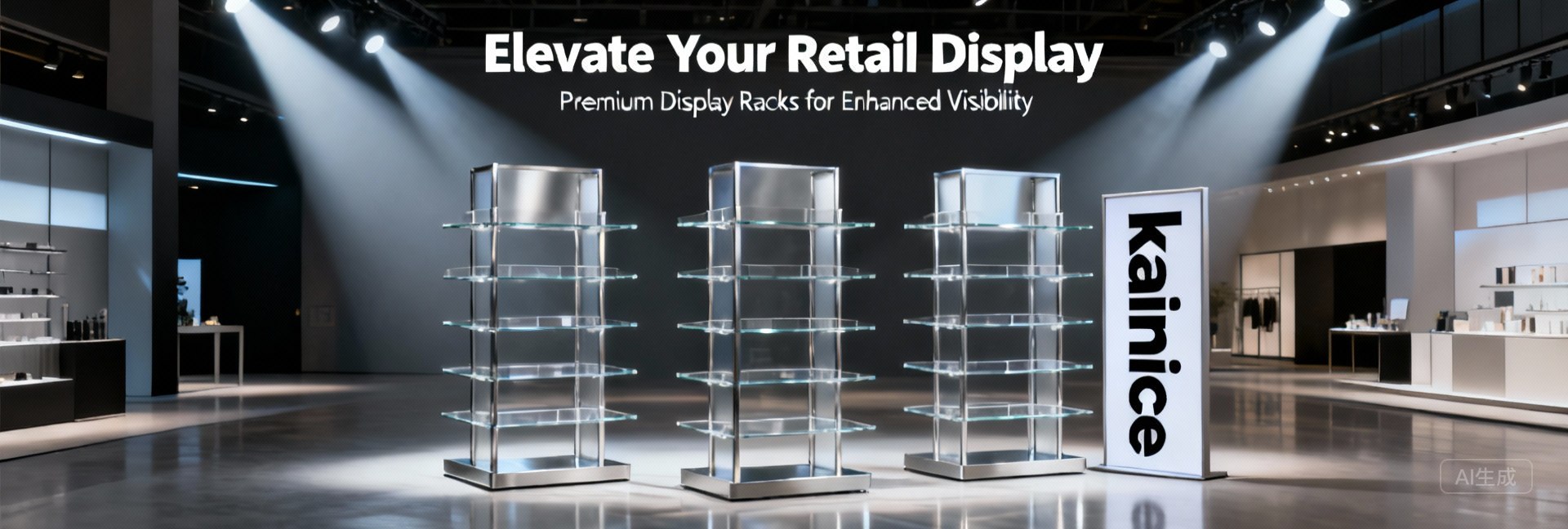
A capable commercial retail store display fixtures factory should offer a comprehensive product portfolio covering the full spectrum of merchandising needs. The standard product categories include:
- Modular display racks — reconfigurable units that adapt to seasonal layout changes
- Gondola shelving systems — the backbone of most retail floor plans, available in single-sided and double-sided configurations
- Slatwall displays — wall-mounted panel systems compatible with a wide range of accessories
- Pegboard systems — perforated panel displays ideal for small packaged goods
- LED lighting fixtures — integrated illumination that enhances product presentation and energy efficiency
On the manufacturing side, a qualified factory must demonstrate proficiency across multiple fabrication processes. Wire bending and welding operations form the structural foundation of pegboard hooks and basket displays. Metal and tube fabrication covers frame construction for gondolas and end caps. Powder coating lines provide durable, scratch-resistant finishes available in virtually any RAL color. Finally, assembly and kitting capabilities enable factories to ship ready-to-install units or knock-down (KD) flat-pack structures that reduce freight volume by up to 60% — a critical factor when sourcing internationally.

Evaluating Factory Direct Pricing and OEM/ODM Support
One of the primary advantages of working directly with a commercial retail store display fixtures factory is the elimination of middleman markups. Factory-direct pricing models can reduce procurement costs by 20 to 40 percent compared to distributor-sourced equivalents. This is particularly relevant for retail chains rolling out standardized fixture programs across multiple locations, where even small per-unit savings compound significantly at volume.
Beyond pricing, OEM (Original Equipment Manufacturer) and ODM (Original Design Manufacturer) support is a differentiator worth prioritizing. OEM arrangements allow retailers to specify custom dimensions, finishes, and branding — such as laser-etched logos or proprietary powder coat colors that align with brand guidelines. ODM partnerships go further, enabling the factory's engineering team to develop entirely new fixture designs from a concept or prototype. Siffron's rapid prototyping capability, for instance, compresses the development cycle for custom display projects, allowing retailers to test concepts in pilot stores before committing to full production runs.
When negotiating with manufacturers, request detailed quotations that break down material costs (steel gauge, wood species, hardware specifications), surface treatment costs (powder coat vs. electroplating), packaging specifications (carton dimensions, KD vs. assembled), and Incoterms (FOB, EXW, or DDP). Reputable factories on Made-in-China.com and Alibaba routinely provide this level of transparency, and many carry certifications such as CE, ISO 9001, and BSCI for social compliance.
Quality Control, Certifications, and Worldwide Logistics
For B2B buyers, quality assurance is non-negotiable. A trustworthy commercial retail store display fixtures supplier will maintain documented quality management systems and welcome third-party inspection. Key quality checkpoints include weld integrity (continuous versus spot welding on load-bearing joints), coating adhesion testing (cross-hatch or tape pull tests), and load capacity certification for shelving rated to hold specified weight per shelf level.
Certifications serve as third-party validation of manufacturing standards. ISO 9001 certification indicates a formalized quality management process. CE marking confirms compliance with European health, safety, and environmental standards — essential for retailers operating in EU markets. BSCI and Sedex audits verify ethical labor practices, which increasingly matter to retailers with corporate social responsibility mandates.
Logistics capability is the final piece of the sourcing puzzle. Established manufacturers maintain export departments experienced in container loading optimization, customs documentation, and multimodal shipping. Some factories offer warehousing and fulfillment services, holding buffer stock for repeat orders and shipping on a scheduled replenishment basis — a valuable service for retailers with rolling store opening programs. When evaluating logistics, confirm the factory's typical lead time (production plus container loading), their experience shipping to your destination ports, and whether they provide mixed-container loading if you are sourcing from multiple suppliers in the same region.
Strategic Considerations for Retail Procurement Managers
Selecting a commercial retail store display fixtures factory should never be a transactional decision. The ideal manufacturing partner becomes an extension of your merchandising team, contributing engineering insight during store layout planning and flagging design inefficiencies before they become expensive field problems. When shortlisting candidates, prioritize factories that demonstrate vertical integration — those who control wire forming, welding, wood machining, powder coating, and final assembly under one roof typically deliver more consistent quality and faster turnaround than brokers who outsource across multiple workshops.
Request factory audit reports, schedule video walkthroughs of production lines, and ask for references from retailers in your vertical. A manufacturer that has successfully supplied fixture programs to apparel chains, grocery retailers, or electronics stores will understand the specific merchandising demands of your category. Finally, consider total cost of ownership rather than unit price alone — a fixture that costs 15 percent more upfront but lasts three years longer, ships flat-pack to save freight, and arrives defect-free will deliver superior value over the life of your store concept.