
If you've spent any real time in retail procurement, you already know the drill. Sourcing reliable cardboard display stands is the difference between a seasonal promo that prints money and a total dumpster fire. I've spent 15 years arguing with factories across Shenzhen and Kunshan. Trust me, the cash wasted on flimsy paper totems is just staggering. Let's skip the supplier fluff and get straight to what actually matters when you're buying these units.
What is the realistic price range and MOQ for a custom cardboard display stand?
Let's talk pricing. If some supplier quotes you under three bucks for a full-size floor unit, just walk away. They're cutting corners. Based on my recent sourcing runs, a standard custom cardboard display stand usually lands anywhere from $3.99 to $38.60 USD. It all depends on the complexity. I recently worked with Kunshan Deco POP Display out of Shanghai. For a bright, multi-tier candy floor standee, we locked in a unit cost right around $15.00 for a 500-piece run.
Then there's the minimum order quantity. Most legit factories—think JC Display Packaging or Shenzhen Leader Display Pdts Ltd—will set the MOQ at 100 pieces. A few might try pushing it to 500 just to make their production run more efficient. If you only need 50 units for a local boutique rollout? Just pay the slight premium. It's really not worth the headache of storing 450 extra units in your warehouse.
How do you ensure the structural quality of a cardboard floor display stand before mass production?
We've all seen it. The sample looks gorgeous, but it completely collapses the second you load it with actual product. That happens because buyers rarely check the flute profile. You have to specify the exact corrugated material. For heavy items, demand B-flute or BE-flute—which is a combo of B and E flutes—for the main structural pillars.
Always request a white sample first. Do this before approving the final printed version so you can test the physical integrity without paying for custom printing plates. I once had a client skip this exact step for a heavy hardware display. The E-flute they chose buckled under just 15 pounds of weight. We ended up airfreighting replacements, which completely wiped out their profit margin on the entire campaign.
What are the common customization mistakes buyers make when ordering a cardboard counter display stand?
The biggest mistake I see? Designing a cardboard counter display stand without accounting for the kickplate and the actual shelf depth. Buyers send over a 2D graphic file that looks perfect on a monitor. But when it's folded into 3D, the graphics wrap around the corners and look completely distorted.
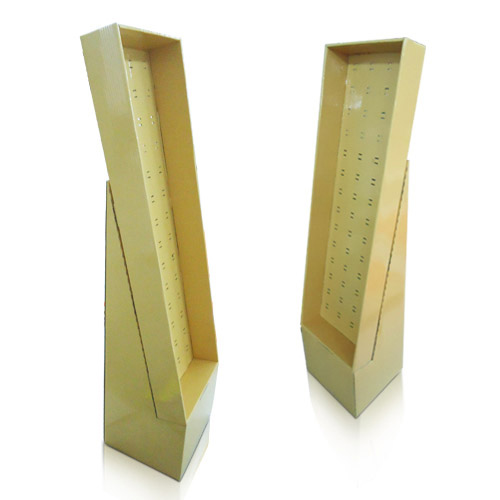
Another massive rookie error is ignoring the loading sequence. Your factory needs to know exactly how the store clerk will assemble it. If it requires 14 steps and a mallet to put together, the clerk is just going to toss it in the recycling bin. Keep the assembly under three simple folds. If it takes more than two minutes to build, your design has failed. Plain and simple.
How long does the actual lead time take for a corrugated cardboard display stand, and what causes delays?
Factories will gladly tell you it takes 15 days. What they conveniently forget to mention is that the clock doesn't actually start until you approve the final pre-production sample and sign off on the digital proofs. In reality, a standard corrugated cardboard display stand takes about 20 to 25 days from deposit to loading the container.
Guess what causes the most delays? Artwork revisions. I had a marketing team go through six rounds of color tweaks on a single promotional totem. Each revision added three days to the die-cutting and printing schedule. Lock your artwork down before you even contact the factory. Once the die-cut mold is made, changing the dimensions means starting completely from scratch.
How do you vet a supplier to ensure they actually manufacture the cardboard retail display stand instead of just trading it?
Alibaba is the wild west. Everyone claims to be a direct manufacturer. To verify if a supplier actually makes the cardboard retail display stand, ask for a live video tour of their die-cutting and mounting machines. A trading company will give you excuses. A real factory will just pull out their phone and show you the floor.
Look for suppliers with verified OEM/ODM capabilities and in-house design teams. Kunshan Deco, for instance, has been majoring in POP displays for over a decade. They have the engineering staff to tweak your structural designs on the spot. If the sales rep doesn't know the difference between CMYK and Pantone matching? You're talking to a middleman.
What specific material specs and certifications should I demand for an outdoor cardboard display stand?
Standard cardboard melts if it so much as looks at a puddle. If you need an outdoor cardboard display stand, you must specify a waterproof coating or use PP (polypropylene) corrugated plastic instead of paper. I've seen suppliers just spray a cheap wax layer on standard corrugated board and call it water-resistant. It lasts exactly four hours in a light drizzle.
Always demand SGS or ISO 9001 certification reports for the raw materials. This is critical if the stand will be in a food retail environment. You need to ensure the inks and adhesives are non-toxic and food-safe. Honestly, if a supplier won't share their certification docs upfront, just walk away. There are thousands of other factories in Guangdong who will.