

If you're sourcing acrylic display stands for your retail shelves, you already know the headache. Finding a reliable supplier for a Plexiglass / Perspex Stand feels like a full-time job. Honestly? Most buyers get burned on their first try. I've spent 15 years in this exact mess, so let's skip the marketing fluff and talk real numbers.
How much should I actually budget for a custom Plexiglass / Perspex Stand per unit?
There is no magic flat rate. Factories like Wuxi Chunzhen New Materials price based on material thickness, size, and process complexity. Take a boutique owner I helped in Texas last year. We sourced a desktop tier using 5mm clear boards—unit cost hovered around $18. Upgraded to 8mm with CNC edge polishing? That price jumped straight to $28.
Walk away if a supplier hands you a blanket quote without asking for CAD drawings or weight requirements. They're just guessing. Depending on your specs, expect to pay anywhere from $12 to $45 per unit. Volume matters, too. Ordering 500 pieces drops that price by about 20% compared to a 100-piece run.
What thickness and material specs do I really need for a heavy-duty Plexiglass / Perspex Stand?
Buyers mess this up constantly. They order 3mm boards for heavy liquor bottles, and the shelves bow out within a week. Lightweight items like lipstick or jewelry? 3mm to 5mm is perfectly fine. Display heavy 3C electronics or glass perfume bottles, though, and you need 8mm to 15mm boards with a reinforced base.
Pay close attention to the seamless bonding process. Cheap factories use too much solvent glue, leaving ugly white marks at the joints. A proper factory uses precise capillary action, making the joints virtually invisible. Always ask for a pre-production sample to check the edge polishing and joint clarity.
Can I get complex custom shapes and logo printing on a Plexiglass / Perspex Stand without crazy MOQs?
Actually, yes. Customization is the whole point of this material. Laser cutting for hollow patterns, hot bending for U-shapes, silk screen printing for your brand logo—it's all possible. The real trick is managing the setup costs.
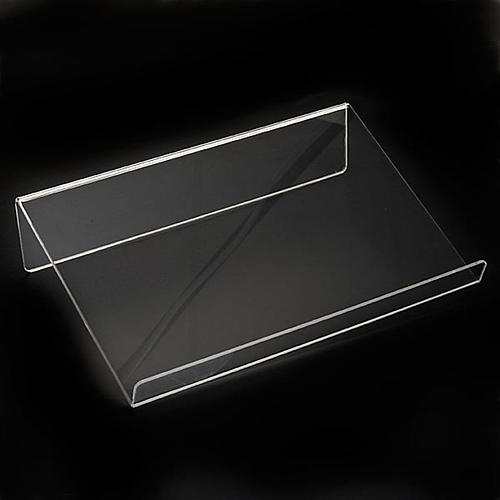
Most suppliers set the MOQ for silk screen printing at around 200 to 300 pieces just to amortize the screen setup fee. Need only 50 pieces? They will either charge you a hefty setup fee or refuse the order outright. Just be upfront about your quantities. Provide a clear PDF or even a hand-drawn sketch, and they can evaluate the hot bending feasibility right away.
Why do lead times for a Plexiglass / Perspex Stand always seem to slip, and how do I prevent it?
The delay is usually on your end, not the factory's. For simple, straight-cut desktop displays, a factory in Wuxi can finish production in 5 to 7 working days after the deposit hits. Complex curved hot-bent structures with multi-color silk screening, though? Expect 15 to 20 working days.
Vague communication is the biggest mistake buyers make. Don't just say "make it look premium." Tell them exactly how the unit will be used, the exact dimensions of the products sitting on it, and the load-bearing requirements. Lock down the final drawing in writing before production starts. Once the machines are cutting, changing even a 5mm tolerance becomes a massive headache.
What are the most common rookie mistakes buyers make when sourcing a Plexiglass / Perspex Stand from overseas factories?
The number one rookie mistake? Thinking this material is indestructible. It has great toughness, sure, but its scratch resistance is terrible. Sound familiar? I once had a client complain that their display looked ruined after a single month. Turns out, their store staff was wiping it down with rough paper towels and alcohol-based cleaners.
You need to educate your retail staff. They should only use a soft microfiber cloth with mild soapy water. Never acetone, never alcohol. Another huge mistake is ignoring the packaging specs. If the factory just throws the units in a single-layer carton, your goods will arrive looking like a jigsaw puzzle.
How should I pack and ship a fragile Plexiglass / Perspex Stand to avoid it arriving in pieces?
Shipping fragile goods overseas is a nightmare if you cut corners on packaging. A reliable supplier uses a three-layer defense. Individual bubble wrap first, followed by pearl cotton to prevent surface friction, and finally a sturdy wooden frame or heavy-duty corrugated carton for the outer box.
For floor-standing units or large multi-tier displays, that wooden frame is non-negotiable. I always tell my suppliers to include a 10% spare parts allowance for critical small components like connector joints. When the shipment arrives, inspect the boxes immediately. Find transit damage? Take photos right there on the dock before you sign the freight receipt.